Content marketing is increasingly vital in corporate growth strategies. However, its execution is multifaceted, requiring numerous processes and resources from planning and production to publication, analysis, and improvement. Particularly in environments with limited staff, efficiently managing these stages often presents a significant challenge.
For web marketing specialists, content managers, and marketing leaders, reducing content production workload, visualizing performance metrics, and selecting cost-effective tools are recognized as pressing issues.
This article will cover the full scope of content marketing tools that help address these challenges. You will gain practical insights, from the main types and functions of tools to specific selection methods based on objectives and issues, and key points for improving quality and efficiency through AI. I will share my experience and knowledge to guide you through tool consideration, implementation, and a clear path to maximizing results.
In Summary
Content marketing tools are essential solutions for streamlining the entire content process—from planning, production, and publishing to analysis and improvement—to maximize results. Proper implementation of these tools leads to workload reduction, improved accuracy in performance measurement, enhanced team collaboration, and cost-effective content operations. Especially in the age of AI, where high-quality content production and optimization for both search engines and AI answer engines are critical, using the right tools will be key to establishing a competitive edge.
Introduction
In corporate digital marketing strategies, content marketing is an essential component. Consistently providing high-quality content is important for building customer trust and aiming for long-term lead generation and brand value enhancement. However, many companies face challenges such as the immense workload involved in content production and the difficulty of accurately measuring its effectiveness, as I've observed.
The digital landscape is changing rapidly, and recent advancements in AI technology are significantly influencing the nature of content marketing. Against this backdrop, implementing the right content marketing tools can be an effective way to solve these challenges and accelerate business growth. This article provides a detailed explanation of specific perspectives for finding the optimal tool among many options, and tips for improving content quality required in the AI era. In the latter half, we will also discuss efficiency improvements through tool integration and important considerations for AI use, so please read to the end.
What are Content Marketing Tools? Why Their Implementation is Important
We will answer the question: What exactly are content marketing tools, and why is their implementation important now?
Definition and Scope of Content Marketing Tools
Content marketing tools refer to a broad range of software and services used to streamline and automate all stages of content marketing, including planning, production, publishing, promotion, analysis, and improvement. These tools vary widely, from those specialized in a single function to integrated platform-type solutions.
Specifically, they include SEO tools for keyword research and competitor analysis, CMS (Content Management Systems) for managing and publishing content, MA (Marketing Automation) tools for automating customer nurturing, analytics tools for measuring content effectiveness, and AI writing tools for article creation support. These tools reduce the workload of team members at each phase and support more strategic decision-making.
Background and Specific Benefits of Implementation
The demand for content marketing tools stems from factors such as labor shortages, increasing content complexity, and intensifying competition. As both the quantity and quality of content are required, there are more situations where manual efforts alone are insufficient.
The specific benefits of implementing these tools are as follows:
- Workload Reduction and Efficiency: Automates routine tasks and data collection/analysis, significantly reducing the time and effort spent on content creation. This allows team members to dedicate more time to creative planning and strategy development.
- Performance Measurement and ROI Visualization: Centralizes content performance data such as access numbers, conversion rates, and search rankings, enabling quantitative measurement of effectiveness. This clarifies return on investment (ROI) and facilitates data-driven improvements.
- Improved Content Quality: Accurate keyword selection and competitor content analysis support the creation of high-quality content that meets reader needs and is favorably evaluated by search engines.
- Team Collaboration and Reduced Dependency on Individuals: Visualizes the production process and facilitates task management and information sharing, thereby improving overall team productivity and distributing workload away from specific individuals.
Key to Content Quality and Results in the AI Era
Recent advancements in AI technology are significantly changing content marketing. AI-powered content generation tools have emerged, enabling faster and higher-volume article creation. However, AI-generated content sometimes carries the risk of unnatural expressions, often referred to as 'AI-likeness,' or misinformation due to insufficient fact-checking.
In this AI era, the key to content quality and results lies in the following points:
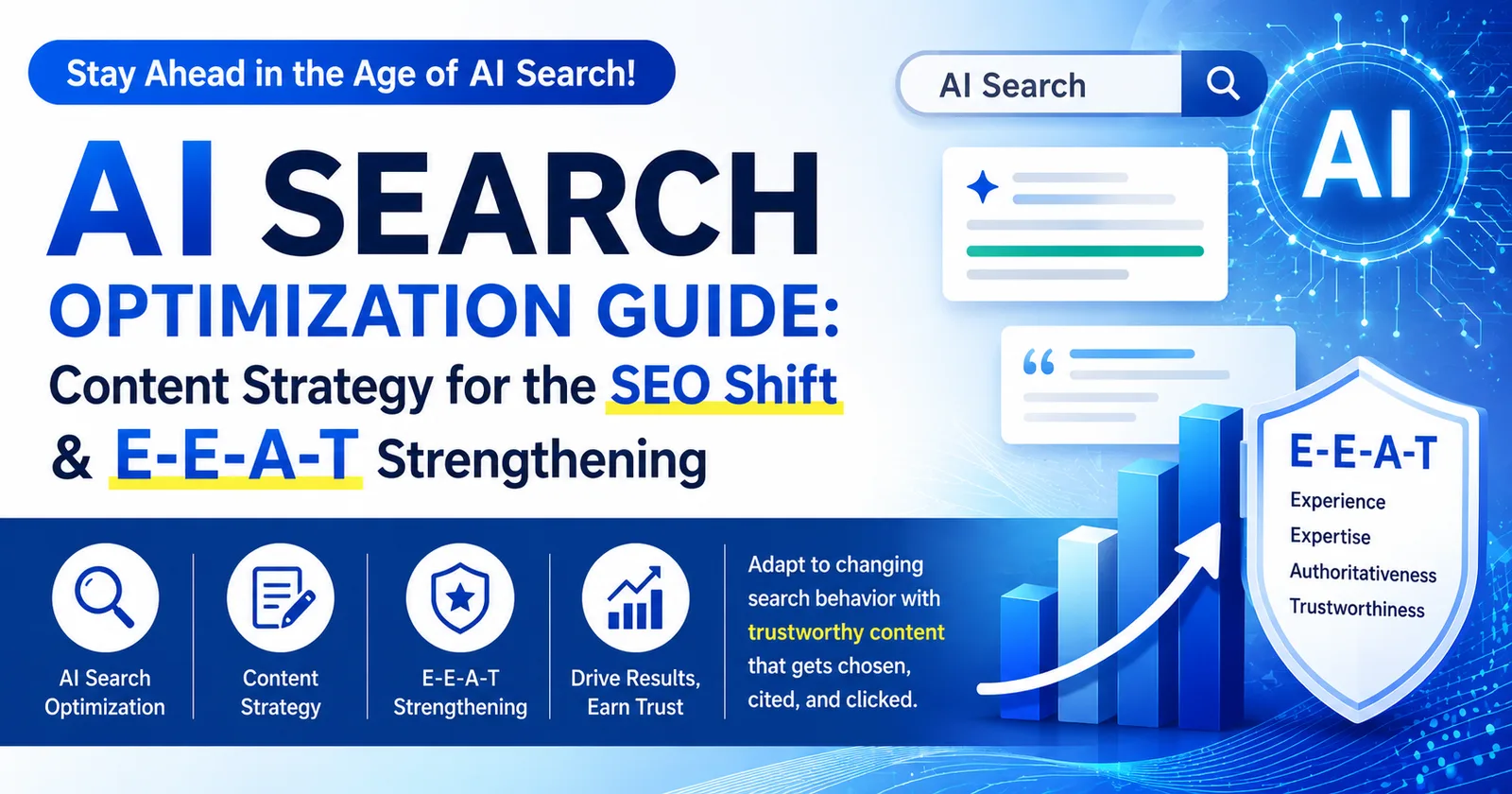
- Ensuring E-E-A-T (Experience, Expertise, Authoritativeness, Trustworthiness): Google emphasizes E-E-A-T in its search quality evaluator guidelines. Even for AI-generated information, it is essential to enhance E-E-A-T through human oversight and the addition of unique insights.
- Fact-Checking and Transparency: A system is needed to verify the accuracy of information output by generative AI and, where necessary, to cite sources. Providing reliable information directly impacts evaluation from readers, search engines, and AI answer engines.
- Balancing SEO with AIO/AEO: Beyond SEO strategies aimed at achieving high rankings in Google Search, optimizing for AI answer engines (AIO/AEO) must also be considered. A structure that allows AI to accurately extract information from content and easily answer user queries is important.
To address these challenges, the use of appropriate content marketing tools is essential. Next, let's look in detail at the specific types and functions of these tools.
重要ポイント
Content marketing tools support the entire process from planning to analysis. Implementing these tools leads to workload reduction, performance measurement, and enhanced competitiveness. In the AI era, using appropriate tools is essential for producing high-quality content.
Main Types and Functions of Content Marketing Tools
We will specifically explain the types and functions of key content marketing tools, including SEO, CMS, MA, analytics, writing, and project management.
SEO-Related Tools (Keyword Research, Rank Tracking, Competitor Analysis)
SEO tools are critical for maximizing organic traffic from search engines.
- Keyword Research Tools: Identify what keywords target readers use to search for information. These tools analyze search volume, competition, and related keywords, aiding in content theme selection and heading structure.
- Rank Tracking Tools: Regularly monitor the search rankings of your content. They help understand performance for each keyword and identify areas for content improvement.
- Competitor Analysis Tools: Analyze the SEO status of competitors' websites and content. This helps understand which keywords they rank for, their backlink profiles, and content strategies, informing your own strategy development.
These tools help increase the likelihood of content appearing in search results and reaching the target audience.
CMS (Content Management System) Tools
CMS (Content Management System) is a system for efficiently creating, managing, and publishing content on a website. A key feature is the ability to update articles and pages with intuitive operations, even without specialized technical knowledge.
- Content Creation and Editing Functions: Use WYSIWYG editors and similar tools to easily create articles and insert images or videos.
- Publishing and Scheduled Publishing Functions: Allows immediate publication of created content or setting it to publish automatically at a specific date and time.
- Version Control Functions: Saves content change history, enabling restoration to previous versions at any time.
- SEO Settings: Basic SEO measures, such as setting meta descriptions, H tags, and optimizing URL structure, can be managed directly within the CMS.
A CMS simplifies the content publishing process, enabling marketing professionals to disseminate information quickly without relying on developers.
MA (Marketing Automation) Tools
MA (Marketing Automation) tools are systems that automate and streamline a series of marketing activities, from lead acquisition and nurturing to customer conversion. By integrating with content marketing, they enable personalized content delivery based on reader behavior.
- Lead Management and Scoring Functions: Collects and analyzes readers' website behavior history and attribute information, quantifying their level of interest (scoring).
- Email Marketing Functions: Automatically delivers personalized email content at optimal times, based on lead scores and behavior history.
- Website Personalization Functions: Dynamically changes website display content according to reader segments, providing more relevant content.
MA tools go beyond simply publishing content; they integrate it into the subsequent customer nurturing process, enhancing lead quality and contributing to ultimate sales.
Content Analytics and Performance Measurement Tools
Content analytics and performance measurement tools are used to quantitatively assess the results of published content and inform future improvements.
- Access Analytics Functions: Measures overall website visitors, page views, time on page, bounce rate, etc. Google Analytics is a prime example.
- Heatmap Tools: Visually display where users click and how far they scroll on a web page. This helps identify reader interests and exit points, aiding in content structure and design improvements.
- Conversion Analysis Functions: Measures the extent to which specific content contributes to achieving goals (conversions), such as document downloads or inquiries.
These tools are essential for clarifying content's "return on investment" and driving a data-driven PDCA cycle.
Content Generation and Writing Support Tools
Content generation and writing support tools aim to improve writing efficiency and quality by assisting with idea generation, outline creation, and text generation in content production.
- AI Writing Tools: Automatically generate article titles, headings, and body drafts by simply inputting keywords or themes. While contributing to workload reduction, fact-checking and human refinement are essential.
- Outline Creation Tools: Suggest optimal article outline proposals based on competitor content analysis results.
- Proofreading and Editing Tools: Automatically check for typos, grammatical errors, and unnatural phrasing, supporting improvements in writing quality.
With the advancement of AI technology, these tools are expected to significantly increase the speed of content production.
Project Management and Collaboration Tools
Content marketing involves various stages—planning, writing, editing, design, publishing, and promotion—and typically involves multiple team members. Project management and collaboration tools help streamline these processes.
- Task Management Functions: Clearly defines who needs to do what by when, and visualizes progress.
- Communication Functions: Facilitates efficient information sharing and feedback within the team.
- File Sharing Functions: Centralizes the management of related files such as proposals, drafts, and images, with configurable access permissions.
These tools are important for strengthening team collaboration, preventing content production from becoming dependent on individuals, and building an efficient workflow.
By now, you should have a good understanding of the main types and functions of content marketing tools. Next, let's look in detail at recommended tools tailored to specific objectives and challenges.
重要ポイント
Understand each tool category and its role in content marketing. SEO tools improve search performance, and CMS streamlines content management. MA helps with customer nurturing, analytics tools visualize ROI, and writing tools support production.
20 Recommended Content Marketing Tools by Objective/Challenge and Comparison
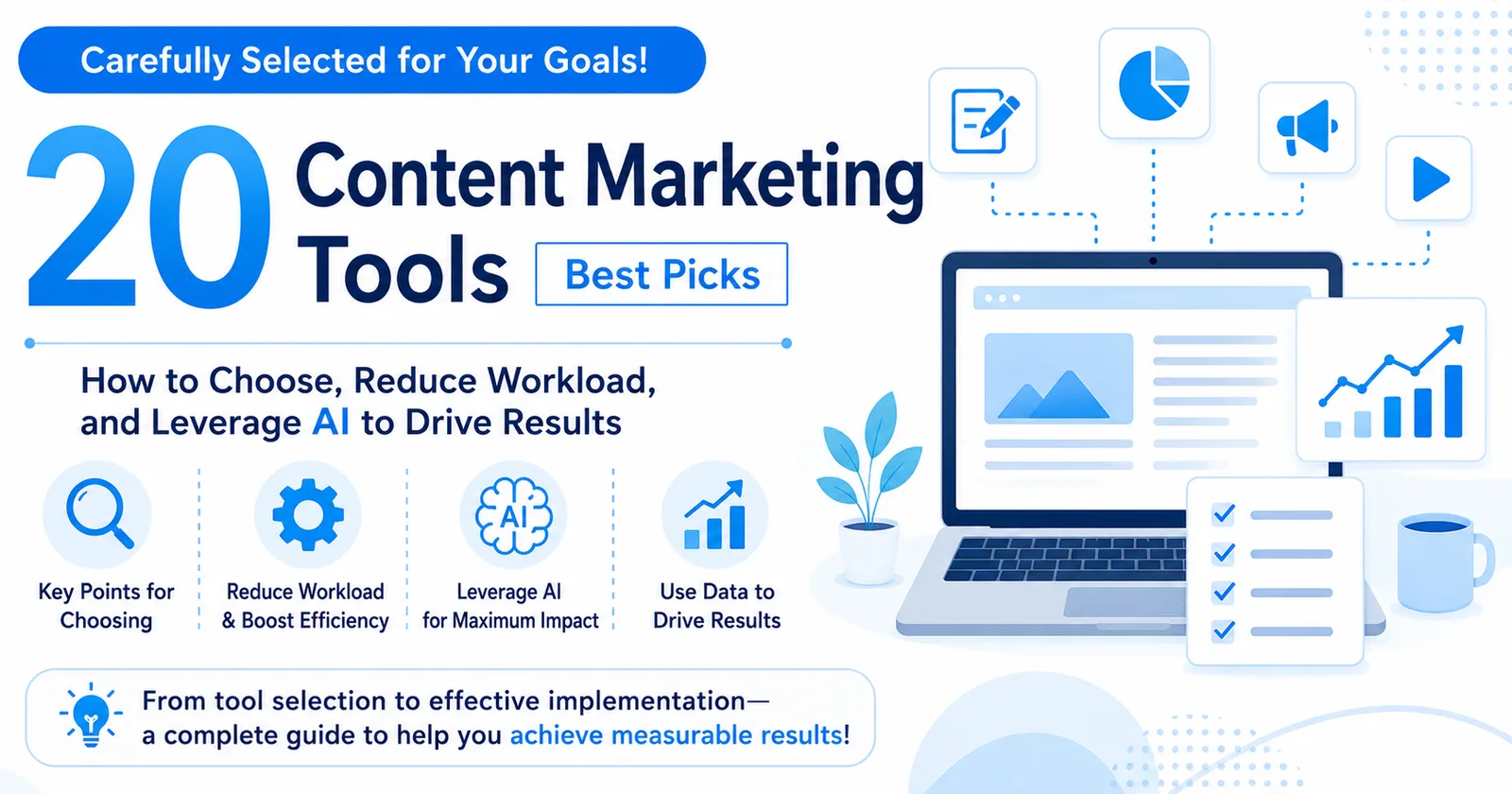
Selecting tools based on specific objectives (e.g., workload reduction, performance measurement, AI compatibility) is important. Here, we present 20 recommended tools, comparing their costs, main features, and strengths.
Tools for Workload Reduction and Automation
These tools help streamline and automate particularly time-consuming tasks in the content creation process, contributing to workload reduction.
These tools support information gathering during the content planning phase and the automatic generation of production elements, enabling team members to focus on creating higher-quality content.
Tools for Performance Measurement and ROI Improvement
These tools are designed to accurately measure content effectiveness and directly improve return on investment (ROI).
Using these tools allows you to understand how much content contributes to business goals and establish a foundation for developing concrete improvement strategies.
Tools Strong in AI-Compatible Content Generation
These tools support the generation of high-quality, reliable content using AI. The key is to identify 'AI-likeness' and ensure the factual reliability of AI-generated content.
When using AI, it is important to establish a system to always verify whether the generated content sounds natural to humans and whether the information sources are reliable.
Free Tools to Start with Lower Costs
These free tools are useful when you want to minimize initial investment or start content marketing for a small project.
While free tools often have limited functionality, they are sufficiently useful for basic content marketing activities. Starting with these tools and then considering paid options as you see results can be a good approach.
Cost-Effectiveness and Selection of Paid Tools
Paid tools offer advanced features and support not available with free options. To maximize cost-effectiveness, it's important to select tools that align with your company's objectives and budget.
- Multi-functionality: Integrated suite-type tools offer consistent data analysis and workflows, optimizing the entire content marketing process.
- Support System: Often includes implementation support and regular consulting, assisting with the effective use of the tools.
- Interoperability: Compatibility with existing CRM or MA tools is also a key selection factor. Data centralization improves the overall efficiency of marketing activities.
Even an expensive tool can be highly cost-effective if its benefits are judged to outweigh its costs. For instance, with a high-speed bus reservation website I launched in 2009, by focusing on SEO and achieving top rankings for key keywords, we grew the business to 2 billion yen in just three years. From this experience, I keenly understand how important investment in creating high-quality content, and the selection of tools to support it, is for business growth.
重要ポイント
Selecting tools based on specific objectives (e.g., workload reduction, performance measurement, AI compatibility) is important. List and compare specific tool names, their cost ranges, main features, and strengths. For AI tools, identifying 'AI-likeness' and ensuring factual reliability are key points.
Key Points for Choosing the Optimal Content Marketing Tool
To choose the optimal content marketing tool, it is important to clearly define your company's objectives and challenges, and compare options from multiple perspectives.
Steps to Clarify Your Company's Objectives and Challenges
The first step in tool selection is to accurately understand your current situation and set specific goals.
Taking these steps transforms a vague desire for "a tool" into a clear perspective on "a tool to solve specific challenges."
Selection Criteria Considering Cost-Effectiveness and Budget
Tool implementation incurs costs. To maximize cost-effectiveness, consider the following points when making your selection:
- Monthly/Annual Costs: Check not only license fees but also initial setup fees and optional costs.
- Cost Reduction Impact: Consider savings in personnel costs, outsourcing fees, and production time resulting from implementation.
- Sales Contribution: Evaluate the potential increase in lead generation and sales due to improved content effectiveness.
- Payback Period: Simulate how long it will take to recover the invested costs.
Even a high-functionality paid tool has significant value if its benefits are judged to outweigh its costs.
Interoperability and Scalability with Existing Tools
A crucial point is whether the tool can integrate with other existing marketing tools or business systems, and if it offers scalability for adding future features.
- API Integration: Verify if an API is provided to facilitate data integration with other tools.
- Centralized Data Management: Confirm that data can be managed centrally without dispersion through tool integration.
- Future Feature Expansion: Check if the tool offers flexibility to add or upgrade features in response to business growth or market changes.
Smooth integration reduces data entry effort, improves analytical accuracy, and enhances the overall productivity of marketing activities.
Checking Usability, Support System, and Security
When selecting a tool, it is necessary to check not only its features but also the following points, considering practical operation:
- Usability: Evaluate whether team members can operate it intuitively and what the learning curve is. Using a free trial period to experience it firsthand is effective.
- Support System: Verify if the vendor's support system is comprehensive, including setup assistance during implementation, troubleshooting during operation, and regular information provision. Availability of Japanese language support is also important.
- Security: Since the tool handles customer data and company content information, ensure that adequate security measures are in place. Check data encryption, access control, and privacy policies.
Strategic Use of Free and Paid Tools
Content marketing tools vary widely, from free options to expensive paid ones. By strategically using both, you can achieve maximum effectiveness while controlling costs.
- Free Tools:
- Benefits: No cost, easy to implement. Suitable for grasping the overall picture of content marketing with basic functions or testing effectiveness in small-scale projects.
- Drawbacks: Limited functionality, with constraints on advanced analysis and automation. Support systems are often less comprehensive.
- Paid Tools:
- Benefits: Offer advanced features, specialized analysis, robust automation capabilities, and extensive support. Many tools have features tailored for large-scale team operations or solving specific challenges.
- Drawbacks: Involve costs. A thorough evaluation of cost-effectiveness before implementation is essential.
It is advisable to first build a foundation with free tools, and once your company's needs and challenges become clear, consider migrating to paid tools with necessary features or using a combination of free and paid tools.
Tool selection must be made with an eye on your company's needs, budget, and future prospects. Next, let's look at common pitfalls in tool implementation and how to avoid them.
重要ポイント
Selection is important based on your company's needs, budget, and future prospects. Also consider interoperability with existing systems and vendor support. Free tools have limited functionality but are useful for starting small.
Common Pitfalls in Tool Implementation and the Path to Success
Tool implementation is not simply a matter of adopting a high-feature product to achieve success. Here, we explain common implementation failures, their avoidance strategies, and a clear path to success.
Considerations to Avoid Implementation Failure
The following common failure patterns are observed in tool implementation:
- Unclear Objectives: Choosing a tool without a clear understanding of what problems to solve or what to achieve, leading to underutilization.
- Insufficient Adoption: Implementing a tool, but frontline staff don't use it because it's too complex or they don't know how, leaving it neglected.
- Overblown Expectations and Mismatch: Overestimating that a tool will solve everything and selecting one that doesn't align with the company's workflows or organizational culture.
- Inadequate Operational Structure: Lack of clearly defined personnel or teams to continuously measure effectiveness and implement improvements after tool deployment.
To avoid these failures, preparation and planning are essential.
Effective Implementation Plan and Internal Structure Development
To ensure successful tool implementation, it's important to proceed with planning in the following steps:
In large-scale system development projects I've worked on, such as developing core systems for travel companies, misalignments among stakeholders during the requirements definition phase posed a risk of significant rework in later stages. The same applies to content marketing tool implementation: clear goal setting and consensus building among all stakeholders in the initial phase are key points that determine the success of the project.
Establishing Data-Driven Operations and an Improvement Cycle
The true value of tool implementation lies in its post-implementation operation and continuous improvement.
- Continuous Performance Measurement: Regularly use the tool's reporting functions and integrated analytics tools to measure content performance.
- Hypothesis Testing: Based on measurement results, form hypotheses like "Why did this content succeed or not succeed?" and consider improvement strategies.
- Implementation of Improvements: Execute improvement strategies, such as content rewriting, structural changes, or promotion method adjustments, based on the established hypotheses.
By running this PDCA cycle, you can maximize the tool's value and steadily improve content marketing results.
Promoting Information Sharing and Collaboration within the Organization
Content marketing requires collaboration not only with the marketing department but also with sales, development, and management—essentially the entire organization.
- Systematize Information Sharing: Establish regular forums for sharing tool usage status, content results, and customer feedback.
- Build Collaborative Structure: Create a collaborative environment where different departments can pool their knowledge and contribute to content planning and improvement.
By ensuring the entire organization understands the importance of content marketing and collaborates, you can maximize the impact of tool implementation.
To prevent selection errors or insufficient post-implementation operation from leading to failure, concretizing objectives and operational plans before deployment is key to success. Next, let's explore how content marketing can be streamlined by integrating multiple tools.
重要ポイント
Tool selection errors or inadequate post-implementation operation can lead to failure. Concretizing objectives and operational plans before deployment is key to success. Maximize tool value through continuous performance measurement and improvement activities.
Streamlining Content Marketing Through Tool Integration
How can content marketing workflows be streamlined by integrating multiple tools?
Specific Benefits of Tool Integration
It is challenging to complete all content marketing activities with a single tool. Integrating specialized tools for each area offers the following benefits:
- Workload Reduction: Eliminates the need for manual data transfer or information gathering between different tools, significantly reducing work time.
- Data Centralization and Improved Analytical Accuracy: Integrates data from various tools, enabling comprehensive analysis from a holistic perspective. This leads to a deeper understanding of user behavior and more accurate strategy formulation.
- Provision of Personalized Experiences: Integrating MA tools with CMS allows for dynamically displaying optimal content based on readers' interests and behavioral history, thus providing personalized experiences.
- Real-time Decision-Making: Real-time data synchronization between tools enables quick responses to changes in market or user behavior, allowing for strategy adjustments.
Common Content Marketing Tool Integration Patterns
Here are some specific examples of effective tool integration patterns.
- SEO Tools + CMS:
- Directly integrate keywords and competitor information identified by SEO tools into the CMS to efficiently create and publish optimized content.
- Automatically monitor the SEO performance of articles published in the CMS using SEO tools to identify areas for improvement.
- CMS + MA Tools:
- Integrate reader behavior data related to content published in the CMS with MA tools for lead scoring and segmentation.
- Personalize CMS displayed content based on reader interests identified by MA tools.
- Analytics Tools + Project Management Tools:
- Integrate content performance data obtained from analytics tools with project management tools to automatically generate or assign improvement tasks to responsible parties.
Specific Examples of Building a Smooth Content Workflow
For example, the following workflow is possible:
In this workflow, each tool collaborates in its area of expertise, allowing for consistent and efficient progress from content planning to improvement.
Importance of AI-Optimized Content Structure
In modern content marketing, content structure must be optimized not only for Google Search (SEO) but also for AI answer engines (AIO/AEO) like ChatGPT and Bard.
- Concise Answers: Present brief and clear answers to questions at the beginning of the content or in specific sections to make it easier for AI to directly answer queries.
- Structured Data: Structure information using formats like FAQs, bullet points, or tables to help AI understand the content more easily.
- Ensuring Reliability: Clearly state fact-checked information and include links to authoritative sources so that AI can refer to trustworthy information.
By designing content structures that enable AI to accurately extract and provide information to users, content is more likely to be evaluated favorably by both search engines and AI answer engines.
Tool integration contributes to workload reduction, data centralization, and improved accuracy. Next, let's look in detail at how to choose AI-powered content generation tools and important considerations.
重要ポイント
Tool integration contributes to workload reduction, data centralization, and improved accuracy. Combining SEO, CMS, MA, and analytics tools enables efficient operation. Aim for a content structure optimized for both Google Search and AI answer engines.
Choosing and Using AI-Powered Content Generation Tools: Key Considerations
AI-powered content generation tools are powerful allies, but their selection and operation require careful consideration. We will explain key points for avoiding 'AI-likeness' and producing reliable content.
How to Identify 'AI-Likeness' in AI-Generated Content
AI-generated content can sometimes exhibit an unnaturalness different from human writing, known as 'AI-likeness.' Key points to identify this are as follows:
- Uniform Expressions: Limited variation in writing, with frequent use of boilerplate phrases or repetitive connectives.
- Lack of Logical Consistency: Although seemingly fluent, there might be logical leaps between sentences or paragraphs, or contradictory information.
- Lack of Specificity: Overuse of abstract expressions, making it hard for readers to visualize. Insufficient concrete examples or data.
- Absence of Emotion or Personality: Lacks human-like emotional expression, author's unique personality, or distinctive perspectives.
If these characteristics are present, the generated content should not be published as is; it requires substantial human editing or rewriting. When selecting a tool, it is important to evaluate the naturalness of the generated text through actual trial use.
Presence of Features to Enforce Fact-Checking and Source Citation
Because AI learns from vast amounts of data, it sometimes faces the risk of 'hallucination,' generating incorrect information as 'fact.' To maintain reliable content, it is necessary to select tools with the following features or establish an operational framework:
- Forced Source Citation: A feature that compels the AI to provide supporting sources (e.g., URLs) for generated information. This makes it easier to verify information.
- Fact-Checking Support: A feature to verify whether generated text contains errors or expressions that deviate from facts.
- Version Control and History: A feature to track which sources the AI-generated content was based on and which version of the AI model was used.
It is essential to either ensure these features are built into the tool or integrate a separate, rigorous human fact-checking process.
Optimizing for Both Google Search and AI Answer Engines (AIO/AEO)
When choosing a content generation tool, it is necessary to consider not only its SEO capabilities but also its evaluation by AI answer engines (AIO/AEO).
- Clear Answer Structure: Does the content have sections that directly and concisely answer user questions? Strategies like placing FAQs or summaries at the beginning can make information extraction easier for AI.
- Information Comprehensiveness: Is the content exploring a specific topic from multiple angles and comprehensively providing related information? AI tends to favor comprehensive sources.
- Expression of E-E-A-T: Is the author's experience, expertise, authoritativeness, and trustworthiness clearly demonstrated within the content? Including author profiles, achievements, and expert supervision are effective methods.
AI places importance on information reliability and expertise. Therefore, evaluate whether the tool can generate valuable, human-like content for readers, rather than just a string of words.
Technologies for Ensuring Quality and Reliability in AI Content Generation
Various technologies have been developed recently to enhance the quality and reliability of AI-generated content.
- RAG (Retrieval Augmented Generation): A technique where AI retrieves relevant information from external databases or documents and generates responses based on it. This enables the creation of accurate content based on the latest information not learned by the AI, or on company-specific knowledge.
- AI-likeness Linter: A tool or feature that detects 'AI-likeness' in AI-generated text and prompts for corrections to achieve more natural expressions. It identifies specific patterns or unnatural vocabulary to help make the text sound more human.
- Semantic Search: A technology that understands user intent and context, not just keyword matches, to find highly relevant information. Applying this technology during content generation can yield higher quality content that better meets user needs.
These technologies contribute to maximizing content marketing results by extending AI capabilities while complementing their limitations.
When selecting AI tools, evaluate natural expression and factual accuracy. Features that clearly indicate sources and evidence are important for enhancing the reliability of AI content.
重要ポイント
When selecting AI tools, evaluate natural expression and factual accuracy. Features that clearly indicate sources and evidence enhance the reliability of AI content. It is important to consider content structure that is evaluated favorably by both SEO and AIO.
Maximizing Content Marketing Results
In this article, we have broadly explained content marketing tools, from their definition to the main types and functions, selection methods based on objectives and challenges, and usage strategies in the AI era.
Content marketing is a significant strategy that enhances corporate brand value and supports sustainable growth over the long term. However, its operation demands considerable time and specialized expertise. By implementing appropriate tools and using them effectively, companies can expect workload reduction, visible performance measurement, and improved content quality.
Finding the optimal tool among a wide variety of options is not an easy task. If you are struggling with selecting tools tailored to your content marketing strategy or streamlining content production using AI, consulting an expert is a valuable option.
By understanding current challenges, selecting the optimal tools, and building an operational strategy to maximize their potential, content marketing will strongly support your company's business growth.
To maximize content marketing results, it's essential not just to implement tools, but also to have an operational plan that leverages them and to run a continuous improvement cycle. From my own experience, I am convinced that the fusion of intrinsic content value and the technology that supports it leads businesses to the next stage.
We hope this information proves helpful for your content marketing strategy.
Related Articles
- Make Growth Inevitable with Digital Marketing Strategy: 5 Principles for AI & Data Utilization
- Methods for SEO High Ranking: Accelerating Business Growth with AI-Driven Development
- B2B Brand Strategy: 3 Steps to Accelerate Growth with AI
- AI-Powered SNS Management Outsourcing: A Strategy for Enhanced ROI
- Accelerating Asia Market Entry Strategy with AI: 5 Steps to Data-Driven Success
From Quantity to Quality: Dominate Next-Generation Search Engines.
Mechanically eliminate unnatural AI-generated text and automatically build highly specialized content based on facts. Our next-generation architecture, which optimizes for both Google Search (SEO) and AI Answer Engines (AIO), gives you a significant edge over competing media.
Consult Our Experts