
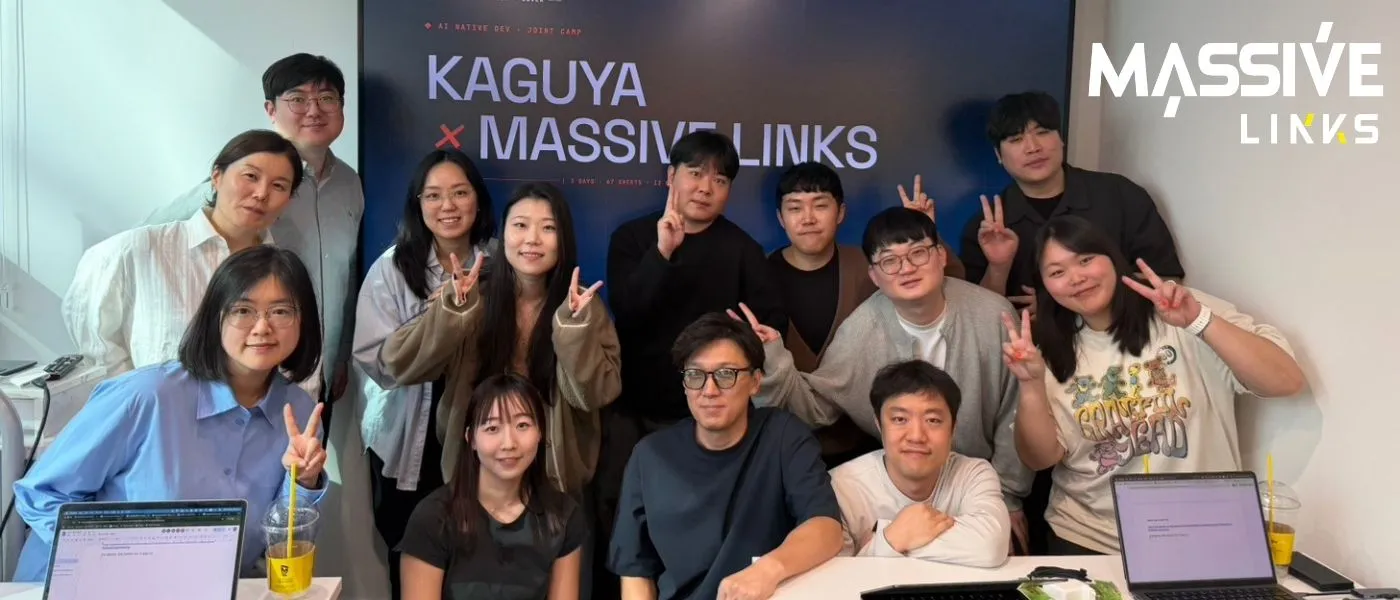
AI-Driven Development Co-Creation Bootcamp Held with KAGUYA Inc.
On April 28–29, 2026, we welcomed members of KAGUYA Inc. to our Seoul office for a two-day, 14-hour intensive AI-driven development bootcamp. Rather than a one-way technology transfer, both teams co-created the future of development together — a record of 16 engineers from both companies building side by side.
Overview
| Item | Details |
| Date | April 28 (Tue) — April 29 (Wed), 2026 |
| Venue | MASSIVE LINKS Office (Seoul, South Korea) |
| Participants | 16 total (KAGUYA Inc. × 4 + MASSIVE LINKS × 12) |
| Duration | 2 Days · 14 Hours |
At a time when AI-generated code is shifting from "assistance" to "the primary driver of implementation," development organizations need a new blueprint for how they work. MASSIVE LINKS welcomed members of KAGUYA Inc. — our partner in AI-driven development — to our Seoul office, where our CEO, PMs, and full-stack engineers (12 in total) held a two-day intensive bootcamp together.
Starting from "Co-Creation"
The theme of the program was simple yet ambitious: build the way we collaborate together. Rather than a one-directional technology transfer, both companies brought their respective strengths to the table as equals, jointly sketching out the future style of development. The "JOINT CAMP THESIS · 2026" declaration at the opening set the tone for the entire two days.
KAGUYA sent four members — their CEO, Data AI lead, Data Architect, and Lead Engineer — all the way to Seoul. MASSIVE LINKS participated with 12 members, including CEO Kazutaka Tanimoto, three PMs, and eight full-stack engineers. A KAGUYA lead engineer also joined remotely for some sessions, making the cross-border collaboration itself part of the learning experience.
Two-Day Curriculum
The program blended lectures, dialogue, hands-on exercises, a hackathon, and retrospectives. Day 1 was designed as a day to "understand through experience," while Day 2 was framed as a day to "co-create our collaboration practices."
Day 01 — Experience (04.28 TUE)
| Time | Session |
| 10:00 — 10:30 | Opening & introductions (aligning expectations, building trust) |
| 10:30 — 11:00 | Concept overview: AI-native development |
| 11:00 — 12:30 | Harness structure & effects (live demo + Q&A) |
| 13:30 — 14:00 | Harness installation (hands-on setup) |
| 14:00 — 14:45 | OpenAPI design + hackathon orientation |
| 14:45 — 16:30 | Hackathon (3 parallel patterns · 105 min) |
| 16:30 — 17:00 | Day 1 quick retrospective |
Day 02 — Co-Creation (04.29 WED)
| Time | Session |
| 10:15 — 11:30 | Hackathon presentations + retrospective |
| 11:30 — 12:00 | Open Q&A session (30 min) |
| 13:30 — 14:15 | MASSIVE LINKS roadmap discussion (45 min) |
| 14:30 — 15:45 | Collaboration setup ① Role division & harness |
| 16:00 — 16:45 | Collaboration setup ② Test strategy & action plan |
| 16:45 — 17:00 | Closing & group photo |
The AI-Native Development Mindset
The starting point of the program was a striking fact: KAGUYA's development runs at nearly 100% AI dependency. This doesn't mean "handing everything off to AI." Rather, while AI takes the lead on implementation itself, humans concentrate their role in understanding and defining requirements, making design judgments, reviewing and taking final ownership, engaging with clients, and maintaining the harness.
AI and humans don't compete — they form a team. AI handles code generation, test creation, refactoring, documentation, and edge-case discovery. Humans focus on specification and judgment. This clear division of roles is what enables high-velocity iteration.
> Don't aim for perfection — build while shipping. Whether you can cycle ship → observe → fix at high speed is the essence of AI-native development.
The Philosophy of the Harness
The most time was devoted to explaining what KAGUYA calls the "harness" — in short, a formalized instruction set for AI. It's an attempt to structure the "art of using AI well" so that it's reproducible by anyone, not just those who've found their own tricks.
The structure has four layers: at the top, "CLAUDE.md" functions as the project's constitution, defining WHY, MUST, and SHOULD. Below that sit seven "rules" files, nine on-demand "skills" workflows, and "settings.json" for automation. Each layer has a clearly defined role, from high-level philosophy down to concrete machine configuration.
What stood out most was the framing of the harness not merely as a "rulebook," but as something that draws the boundaries of trust. By codifying what AI may and may not touch, teams reduce review overhead while enabling high-freedom implementation. This perspective was a fresh discovery for our team as well.
Three-Pattern Parallel Hackathon
The highlight of Day 1 was a three-pattern parallel hackathon. Three groups tackled the same challenge under three different conditions — "no backend prepared," "backend ready," and "harness in place" — running simultaneously so teams could observe each other's friction points and time allocation.
The retrospective revealed a clear finding: in the AI-native era, the time sink is not implementation itself, but the boundary between environment setup and verification. This showed up starkly in the data.
Six Key Takeaways
The main lessons articulated in Day 2's retrospective session:
01. Without a foundation, AI just spins its wheels
If the backend isn't ready, code can be written but the system won't respond. Teams learned firsthand that Backend / GCP / Firestore setup must happen before bringing AI in.
02. The harness draws the boundaries of trust
AI behavior and human cognitive load change dramatically with vs. without a harness. Sharing just four files is enough to instantly establish no-edit zones and shared agreements.
03. The spec is the Single Source of Truth
When both teams reference a contract — explicitly defined in OpenAPI / JSON Schema — implementation-to-spec drift plummets and rework in review is structurally reduced.
04. Build test coverage gradually
Rather than targeting 80% coverage from day one, the pragmatic approach is Phase 1 (50%) → Phase 2 (70%) → Phase 3 (TDD standardized), calibrated to the team's maturity.
05. Sequence matters more than completeness
"Written in the order that prevents getting stuck" is more cost-efficient than "written carefully." Even in the AI-native era, the fundamentals of designing human-readable documentation don't change.
06. People and AI are a team
Position AI as the driver of implementation, not a tool. Humans concentrate on specs, judgment, and review. This clear division of roles is what sustains high-velocity iteration.
Looking Ahead
This bootcamp is positioned not as a one-off event, but as the starting point of a long-term joint development partnership between our two companies. Three concrete milestones were set:
- May 5, 2026 — Share a draft of shared collaboration rules
- May 12, 2026 — Kick off a small dry-run task
- May 27, 2026 — Retrospective with Harness v0.2
MASSIVE LINKS plans to gradually incorporate the insights from this program into our internal development processes. The paradigm shift of positioning AI as the primary driver of implementation while humans focus on spec-setting and judgment holds real potential to raise both our development velocity and output quality.
We extend our heartfelt gratitude to the team at KAGUYA Inc. for making the journey to Seoul and for the care they put into designing and facilitating the program. We look forward to growing the dialogue from these two days — built as equal partners — into something much larger through our shared development work ahead.